The Empty Landscape Is Not Empty
Western landscape framing shapes how a scene feels: learn to read horizons, light, colour and camera movement for a richer sense of place.
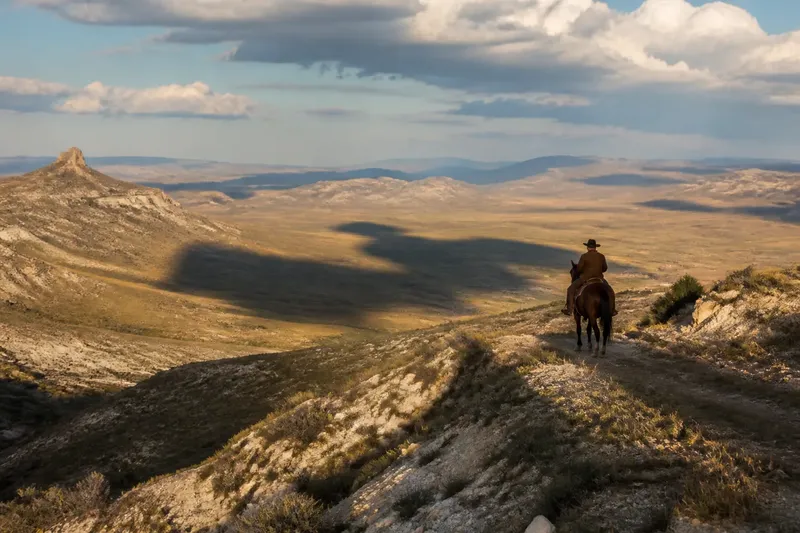
A rider crosses a pale ridge as the frame holds on the long shadow of a cloud. In Western films, landscape framing can make a familiar stretch of country feel solemn, restless or oddly calm. Watch how the image changes the land’s mood, rather than treating every open view as a puzzle about what lies outside it.
A camera can make the same valley feel harsh in hard midday light and tender at dusk. A slow pan may invite the eye to linger, while a locked-off shot lets a rider’s movement become the scene’s main event. These choices shape how the audience experiences a place, even when the story says little about it.
Western landscape framing
Start with the frame’s shape and balance. A low horizon gives the sky room to dominate; a high one makes the ground’s texture and contours more prominent. Neither choice has a fixed meaning. A broad sky can feel liberating under soft light, or oppressive beneath gathering storm clouds.
Notice where the camera puts the figure. A rider crossing from one side of a wide shot to the other may seem to travel through a landscape that barely changes. If the camera follows, the view feels more closely tied to the rider’s passage; if it stays still, the terrain can appear to outlast the person moving through it.
Pay attention to the depth of the image as well. A foreground rock, a middle-distance trail and a far-off ridge give the eye several places to rest. A shallow, hazy view can flatten those layers, making the country feel more like a painted expanse than a route with clear stages.
Light and colour
Light gives land a changing texture. Low sunlight can stretch shadows across a plain and pick out the edge of a butte; flat, overcast light softens those contrasts. Ask how the lighting affects the scene’s pace and feeling, rather than assigning a single mood to a particular time of day.
Colour works in a similar way. Dusty browns and muted greens can make a scene feel restrained, while a bright blue sky may sharpen the contrast between a figure and the country around them. In black-and-white films, look instead at tonal contrast: a dark coat against pale ground can pull the eye towards the rider before the landscape comes into focus.
Imagine a traveller arriving at a shallow valley in the late afternoon. The starting view has warm light on the slopes and a dark foreground; the camera then pans to keep the traveller in view as they descend. The resulting shift makes the valley feel welcoming at first, then more enclosed as the shadowed ground fills the image. That invented scene shows how light and movement can alter the feel of one place without changing its physical features.
Movement and duration
A travelling shot can make the landscape seem to unfold alongside a character. Compare it with a static view: there, the person passes through an image that remains fixed. The difference can make the scene feel intimate, distant or deliberately patient, depending on its pace and what the character does.
Duration matters, too. A shot that lingers after a rider exits can leave the eye on grass, rock or shifting light. A quick cut to the next scene keeps the landscape in the background. It is not worth the effort to find an elaborate hidden meaning in every held shot; sometimes it simply gives the action room to settle.
Look for changes within the shot. A cloud moving over a ridge, dust rising behind a horse or a figure pausing at a stream can give a still composition its own rhythm. The camera need not move for the landscape to feel alive.
What should you notice?
Does the camera move with the rider?
Check whether the frame follows the figure or stays put as they cross it. If it follows, read the country as a companion to the journey; if it stays still, notice how the landscape holds its shape around the passing person.
How does the light shape the terrain?
Look for where shadows fall and which details stand out. If the light sharpens ridges or tracks, follow those lines; if it softens them, notice whether the scene feels less exposed or simply harder to read.
Where does your eye land first?
Compare the figure’s contrast and position with the brightest or darkest parts of the image. If a face or coat catches the eye, follow its movement; if a landmark dominates, consider how it sets the scene’s scale and direction.
What changes before the cut?
Notice whether the character moves, the light shifts or the camera reframes before the scene ends. If the image changes gradually, let that change guide your reading; if it cuts abruptly, compare the new view with the one it replaces.
Framing in practice
For a simple viewing exercise, jot down three observations after a landscape shot: where the horizon sits, what moves, and which part of the image draws your eye. Then compare those notes with the next shot. This keeps attention on choices visible in the film, rather than on guesses about a place’s supposed symbolic meaning.
Say you are watching an invented scene in which a rider approaches a stand of cottonwoods. The first shot places the trees high in the frame and the rider low against the plain; the next tracks beside the horse as the trees fill the view. The practical reading is that the edit shifts attention from the traveller’s smallness to the approaching shelter. That is one possible effect, not proof of a fixed intention.
Western landscape framing is most rewarding when you watch how a scene’s choices work together: the position of the horizon, the quality of light, the camera’s movement and the time allowed for the image to settle. If those details seem to pull in different directions, keep the tension in your reading. A beautiful view can also feel uncomfortable, and a quiet one can carry a strong sense of motion.