A Western Double Feature Built Around the Same Kind of Doorway
A Western double feature about doorways reveals how entrances can signal welcome, refusal or departure—and gives you a sharper way to compare two films.
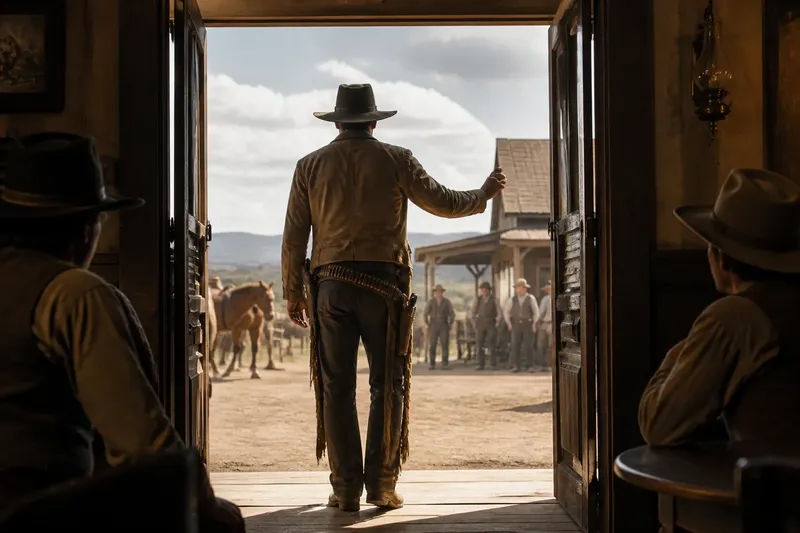
You pause a Western as someone reaches a saloon entrance: one hand on the frame, the room beyond busy with witnesses. For a moment, the doorway seems to hold the whole scene still. Build a Western double feature around doorways like this and you can watch two films answer the same question in different ways: who gets to cross, and what changes when they do?
The pairing is not a hunt for matching buildings. It is a way to follow a repeated screen image and notice the choices hidden inside it. A threshold can welcome a character, make entry conditional, or turn a departure into a public act. The most revealing comparison comes from attending to the doorway’s dramatic job rather than simply counting how often a door appears.
Start with the threshold
A doorway divides spaces, but a film can make that division mean much more than indoors and outdoors. The interior may stand for shelter, authority, family life or a crowded community; the exterior may suggest exposure, freedom, danger or a return to the trail. Those meanings are not fixed. The scene’s framing, sound, blocking and point of view help decide what the crossing means now.
It helps to distinguish a doorway from a general entrance. A character arriving at a town’s edge may be entering a new social world, but a door gives the boundary a visible frame. Someone can pause in it, block it, hold it open, slam it, or remain on one side while addressing a person on the other. That gives the scene a small stage on which permission and refusal can be played out.
Look beyond hinged doors. A saloon’s swinging doors, a ranch-house entrance, a jail cell, a church door, a hotel lobby or the opening of a covered wagon can all work as thresholds. The useful question is not whether the structure is technically a doorway, but whether the image makes crossing between spaces part of the scene’s meaning.
Choose a useful pair
For a strong double feature, choose films with at least one comparable threshold scene in each. They need not share a plot, setting or production style. In fact, a difference in tone can make the comparison more interesting: one film may treat an open door as an invitation, while another makes the same kind of entrance feel like a trap.
Start by thinking of a doorway function rather than a specific building. You might pair two films around a character’s first entry into a public room, a refusal of shelter, a confrontation staged across a threshold, or a final exit that leaves someone behind. Then check that each film gives you a scene to follow. A title alone is not enough to establish a useful match; the scenes themselves need to offer comparable choices.
Try to keep the viewing question narrow. “What do these films say about the West?” is so broad that almost any difference can seem relevant. “How does each film make a person’s entry into a room feel voluntary or imposed?” gives you a workable thread, while leaving space for the two films to reach different conclusions.
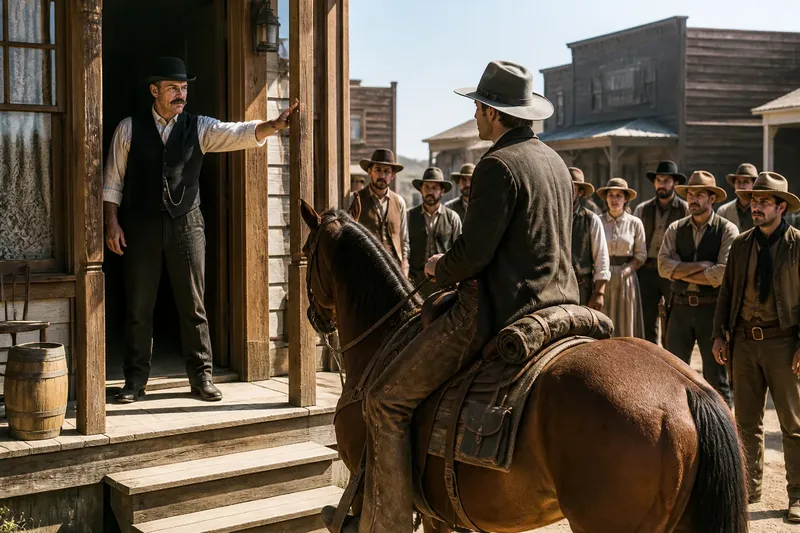
Say you choose two films in which a newcomer reaches a ranch-house door during a dispute. In the first, the resident steps aside and leaves the entrance unobstructed; in the second, someone stands squarely in the opening and answers without moving. You could watch for whether each newcomer crosses, waits or withdraws, then ask how the framing and other characters’ reactions shape that choice. That is an invented viewing scenario, not a claim about any particular film.
Watch the crossing
As each film begins, notice who controls the approach. Does the arriving character walk straight to the entrance, hesitate at the edge of the frame, or come into view only after someone inside has called out? Is the person already expected, or does the scene make the arrival a surprise? A doorway can give the person inside the power to recognise, ignore or challenge the visitor before either character speaks at length.
Then track who occupies the threshold. A figure standing in a doorway can make an ordinary opening feel guarded without touching a weapon or issuing a direct threat. Someone who stays inside while addressing a person outside may claim the safer ground; someone who steps out may abandon that position. Watch the balance of bodies, not just the words: a slight shift can change who appears to set the terms.
Pay attention to whether crossing is completed. An arrival may stop at the sill; a character may enter only after another person moves aside; a visitor may be admitted but kept near the door. Those choices allow a film to distinguish physical access from acceptance. A character can be inside the room and still remain socially outside the group.
Sound can also give an entrance weight. A door opening against a quiet room may draw attention to the newcomer, while conversation or music that continues without interruption can make the arrival seem unimportant—or deliberately ignored. Listen for the moment the room responds, if it does at all. The pause, greeting, laugh or silence can tell you what the doorway alone cannot.
Compare the frame
Once you have the action, compare how each film shows it. A doorway may be held in a wide composition that includes people on both sides, making the boundary and its witnesses visible. Or the camera may isolate a face, a hand on the jamb or the visitor’s view into the room, leaving the exact distance between characters uncertain. Neither approach carries one universal meaning; it changes what the audience is invited to notice.
Look at whether the frame makes the entrance feel like a passage or a barrier. An open composition may let the eye travel through the room and towards the world beyond it. A dark interior against a bright exterior can make the opening read as a patch of uncertainty, while a bright, crowded room may make the outside seem lonely by contrast. Notice what the lighting actually directs you towards instead of assuming darkness means danger or daylight means safety.
Editing offers another point of comparison. A film might show the approach, the response and the crossing in one sustained view, allowing a hesitation to last. Another might cut between visitor and resident, giving each a separate reaction and making the exchange feel more confrontational. Ask what information the cuts withhold or reveal: do you know who is watching, what lies behind the door, or whether the visitor has been recognised?
Do not overlook the view from the threshold. If the camera stays with someone outside, the room can appear inaccessible even when the door is open. If it places the audience inside, the incoming character may feel like an intrusion. The physical action can be identical while the camera’s position quietly changes whose space the scene seems to defend.
Read the social stakes
In a Western, a room is rarely just a room. A saloon may gather strangers and local regulars; a ranch-house entrance may mark the boundary between household and hired work; a jail cell places entry and exit under official control. The doorway lets a film show those arrangements in a concrete way. Who can cross without asking? Who must announce themselves? Who is allowed to remain?
Arrival can expose a character’s standing. A visitor welcomed by name may have a claim on the community; someone left outside while the room carries on may be treated as a threat, an inconvenience or an outsider. But do not reduce the scene to a single symbolic code. A guarded entrance might protect vulnerable people, enforce unfair control, or do both at once. Let the film’s surrounding actions guide the reading.
Refusal can be more complicated than a locked door. A character may be invited in but choose to stay outside, perhaps to keep distance from the people within or to preserve a route back. Conversely, someone may cross after being told not to, making entry an act of defiance. The important distinction is between who has the power to decide and who accepts the decision.
Departure deserves the same care. A person stepping through a door may be leaving a room, a relationship or a role in the community; the film may make the exit temporary, final or deliberately unclear. Notice who watches the person go and whether the camera follows. A departure seen from inside can leave the remaining characters with the consequence; a view from outside can make the building feel like a place being left behind.
Questions for the pairing?
Does a Western doorway always signal danger?
No. It can frame hospitality, routine, work or privacy just as readily as threat. The scene’s tone comes from who controls the entrance, how others respond and what the film lets you see beyond it.
Should the two films have the same kind of building?
Not necessarily. Comparing a saloon entrance with a ranch-house door can be productive if both scenes turn on arrival, permission or departure. The contrast between a public gathering place and a household may help clarify how each film imagines belonging.
What if one film barely uses doors?
Look for another framed crossing, such as a jail-bar opening, a gate or the entrance to a covered space. If no threshold becomes dramatically significant, choose a different pairing rather than forcing the image to carry a meaning the film does not give it.
How can I keep notes without interrupting the films?
Write down a few words after each relevant scene: who approaches, who controls the opening, and whether the crossing happens. You can return to the moment later if you want to compare a particular cut, composition or sound cue.
Keep the viewing focused
A small note-taking routine helps without turning a double feature into homework. Before watching, write one question about the threshold; after each film, jot down the scene that best answers it and one detail of screen craft. Leave the deeper comparison until both stories are fresh. You are trying to preserve a few useful observations, not produce a complete inventory of every entrance.
It is not worth pausing at every door or treating every window as a hidden symbol. If a crossing has no effect on the action, relationships or the way a scene is framed, let it pass. The pattern matters because the films give it dramatic work to do, not because the viewer has decided in advance that every opening must mean something.
Once the second film ends, compare what the doors permit and what they withhold. One may treat entry as an offer that can still be refused; the other may show that physical access does not amount to belonging. That contrast is the pleasure of a Western double feature about doorways: a familiar entrance becomes a precise way to watch a community draw its boundaries, one crossing at a time.