Before the Monumental Western: The Genre’s Early Screen Shape
Early western film conventions took shape through familiar stories and screen techniques; learn to recognise their changing patterns without treating later rules as original.
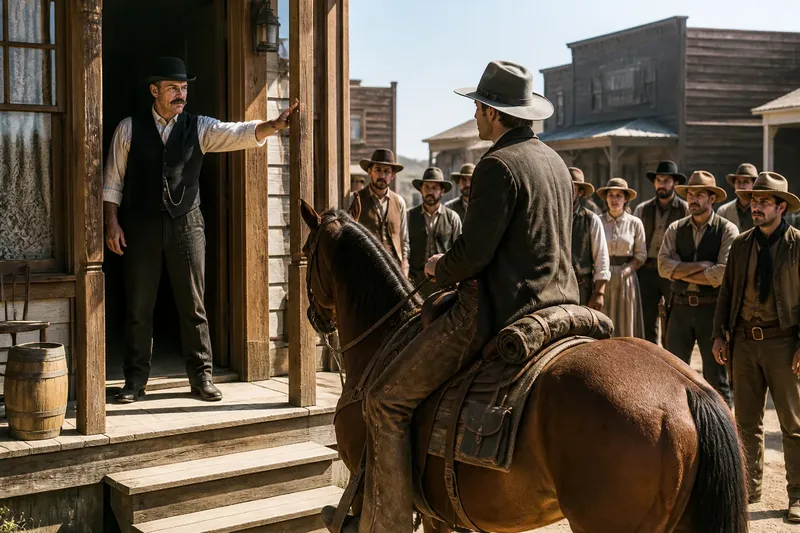
A rider crosses a street, pauses at a doorway, and turns as the townspeople gather. Early western film conventions took shape through such readable actions, but not from a settled formula: filmmakers were still working out how movement, performance and editing could make a frontier story clear on screen.
To recognise the early western, it helps to look beyond familiar scenery. The genre’s screen language grew through practical choices about staging, gestures and the order of shots, while its stories drew on popular ideas about settlement, authority and belonging. Later westerns inherited these devices, then altered their meanings.
Silent screen language
In silent films, a glance, a raised hand or a sudden entrance could carry information that dialogue would later spell out. Actors often used broad gestures, not because every performance was the same, but because movement had to remain legible across the screen. A film’s meaning could turn on who notices a threat and how quickly the others respond.
Editing helped organise that action. A cut from a rider approaching to a family waiting inside could connect two places and make the impending encounter clear. Watch for entrances, exits and reactions: they show how a film guides attention, even when its plot is spare.
Staging the conflict
Early western stories often made trouble visible through a physical action: a door is blocked, a horse is taken, or a meeting breaks into a fight. These moments were suited to screen storytelling because viewers could see the stakes unfold. A familiar plot ingredient, however, did not dictate a single moral reading.
Consider who initiates the action, who answers it, and whose reaction the film lingers on. A character may appear to restore order, yet the staging can leave open whose interests that order serves. That uncertainty is more revealing than assigning every role a fixed label.
Say you watch an invented silent western in which a traveller enters a boarding house and finds the owner barring a miner from the dining room. First, note the traveller’s entrance and the owner’s gesture; next, watch whether the miner is shown responding or waiting; then observe whose movement prompts the next cut. If the film follows the traveller, the scene gives that outsider the power to frame the dispute; if it holds on the miner, the conflict may instead centre on exclusion.
Early western film conventions?
What screen techniques distinguish early westerns?
Look for expressive gestures, clearly arranged entrances and exits, and editing that links a threat to a response. These techniques appear in many kinds of early films, so their meaning depends on how they serve a western story.
Were silent westerns always simple?
No. A plot might be easy to follow while leaving motives or justice unresolved. Clear action made events legible; it did not require a simple account of who deserved power.
How did editing shape western stories?
Editing could connect distant locations, bring a character’s reaction into focus or make an approaching danger feel urgent. Notice what a cut asks you to compare, rather than treating each shot as an isolated image.
Why do early westerns differ from later ones?
Filmmakers and audiences developed different habits as screen storytelling changed. Later films could reuse a confrontation or a hero’s entrance while giving it a slower pace, a more complex motive or a different outcome.
Recurring story patterns
A lone arrival, a threatened household or a public confrontation can recur without forming a rulebook. The same pattern may introduce a defender in one film and an unwelcome outsider in another. Compare what the character does and how the community responds, rather than treating a repeated plot device as proof of a fixed formula.
For a quick viewing note, record the following observations and use each to decide what to examine next:
- Check whether the opening follows a traveller or a settled character; if it follows a traveller, track how the arrival changes events, then compare with a film that begins inside the community.
- Check who makes the first visible move in a confrontation; if one character acts and another only reacts, note whose agency the scene foregrounds, then watch for a later reversal.
- Check whether a gesture is repeated or answered; if it is answered, follow the exchange, then compare it with a scene where the same gesture receives no response.
- Check where a cut takes you after a threat appears; if it moves to a waiting character, note how that reaction shapes suspense, then compare with a cut that stays on the source of danger.
- Check whether the gathering watches, joins or disperses; if the crowd intervenes, consider how the film presents public authority, then compare with a conflict left to individuals.
- Check what changes after the confrontation; if a character’s role or access changes, note the outcome, then compare it with a resolution that restores the earlier arrangement.
Imagine a viewer watching an invented silent western about a traveller accused of taking a horse. The viewer notes that the traveller enters first, the rancher points towards the stable, the film cuts to a watching crowd, and the crowd stays back. The viewer then sees the traveller return the horse but leave town alone. Taken together, those steps suggest that the film makes accusation public while leaving the traveller without a place in the community; a different ending, such as the crowd intervening, would shift the emphasis towards collective judgement.
Changes across films
It is easy to let later westerns turn their own conventions into an imagined origin. A lone rider or a final showdown may feel inevitable after repeated exposure, but early films used recurring devices in varied ways. Compare a film’s choices with another’s rather than arranging them into a tidy ladder of progress.
It is also not worth chasing one definitive first convention or forcing every early western into a single family tree. A more useful distinction is between a story ingredient and its screen treatment: a confrontation might recur, while the gestures, cuts and consequences change.
Early western film conventions become easier to understand when you follow how a scene communicates, not just what happens in it. Note who initiates the action, how the film directs your attention and what the outcome leaves unresolved. Those details make the genre’s early screen shape clearer without mistaking its developing habits for permanent rules.